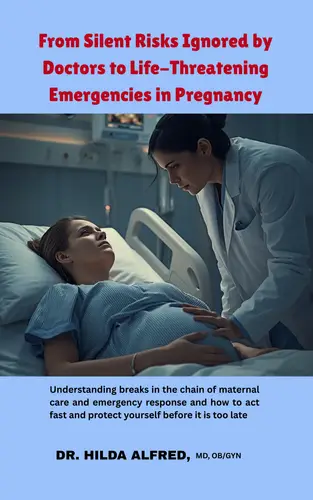
Description
Why this book? Your voice is the one voice that will be there for every single moment of this journey. So you need to understand the silent risks that signal danger and how to act before it’s too late.
I’ve sat with too many families in too many hospital rooms, watching them try to make sense of what happened. I’ve reviewed too many charts where the warning signs were right there—written in plain language, reported by the mother herself—but somehow got lost in the noise of a busy system. I’ve carried too many stories in my heart, stories of women who trusted that someone would connect the dots, and the dots never got connected. And they died!
Writing this book is my way of making sure that doesn’t happen to you. I want you to think of these pages as an extension of my clinic—a quiet space where we can talk honestly about what matters.
You might be wondering: why should I have to learn all this? Shouldn’t the doctors and nurses just know?
Yes. They should. And most of the time, they do. I’ve worked alongside countless dedicated, brilliant colleagues who give everything they have to protect the mothers in their care. But healthcare systems are human systems. They get busy. They get tired. They make assumptions. And sometimes, in the rush of a thousand things happening at once, a single voice gets lost, and that might be the cause of a disaster.
Your voice is the one voice that will be there for every single moment of this journey. So you need to understand the silent risks that signal danger and how to act before it’s too late. Doctors will rotate. Shifts will change. Notes will get misplaced. But you will be constant. You will be the thread running through every appointment, every symptom, every decision. That gives you a power you may not have realised you had.
This book is about helping you use that power, not to fight with your care team, but to partner with them. The best outcomes I’ve seen in my career happened when a mother and her providers worked together.

Felicia Jones –
The “Doctor Dismissal Log” is genius. I documented every time they said “it’s normal.”
Shirley T. –
I waited until I felt sick. Don’t wait. Read this at 20 weeks.
Pamela E. –
Maps out the 7 days of decline. I realized I was on day 4. Rushed to the ER.
Jacqueline Adeyemi –
I highlighted passages and handed the book to my OB. She apologized and ran the tests.
Helen R. –
My shortness of breath was ignored. This book said “ask for a PE test.” I had a clot.
Katherine –
Essential for anyone with health anxiety. It separates “mom anxiety” from “clinical red flag.”
Martha –
Validates the gut feeling. If you feel “off,” this book tells you to trust that.
Georgina –
Explains the exact line between migraine and preeclampsia. I crossed it at 35 weeks.
Rita –
I had a “silent” infection. This book explained why my fever was low but my heart rate was high.
Brenda –
The “Silent Sepsis” chapter saved my life at 2 weeks postpartum. I had no fever, just fatigue.